Key Takeaways
Start with the thermostat, furnace switch, breaker, filter, and open vents.
Do not remove sealed panels, adjust gas components, bypass switches, or work on wiring.
Gas odors, carbon monoxide alarms, burning smells, repeated breaker trips, and loud mechanical noises require prompt professional attention.
Regular filter checks and annual maintenance can support dependable heating performance.
Table of Contents
Why Furnaces Stop Working
Start With Safety
Check the Thermostat
Inspect Power and the Furnace Switch
Check the Filter and Airflow
Match the Symptom to a Possible Cause
When to Call a Heating Professional
Simple Preventive Care
Frequently Asked Questions
Conclusion
When damp South Puget Sound weather settles into Olympia, a furnace that will not start can quickly make a home uncomfortable. Before scheduling furnace repair in Olympia, WA, homeowners can safely check a few common causes, including thermostat settings, electrical power, and airflow. Sunset Air provides residential heating diagnostics and repair for Olympia and nearby Thurston County communities, with services for furnaces and other home comfort equipment.
These steps are intended for basic, external checks only. A furnace contains electrical controls, moving parts, combustion equipment, and safety switches that should not be handled without training. Following a practical sequence of furnace troubleshooting steps can help homeowners rule out simple issues without taking unnecessary risks.
Why Furnaces Stop Working
A furnace may stop heating because of a simple setting, a power interruption, restricted airflow, or an internal component problem. Even gas furnaces need electricity for the thermostat, ignition system, controls, safety switches, and blower. Common starting points include a thermostat set to cooling, depleted thermostat batteries, a clogged filter, a tripped breaker, a switched-off service disconnect, blocked vents, or an access panel that is not fully seated.
Many common furnace problems begin with symptoms that seem minor, such as weak airflow or a furnace that starts and stops too soon. However, ignition failures, blower motor issues, flame-sensing faults, control problems, and condensate drainage issues on high-efficiency equipment need a qualified technician to diagnose them correctly.
Start With Safety
Stop troubleshooting immediately if there is a gas or rotten-egg odor, a carbon monoxide alarm, smoke, a burning-plastic smell, repeated breaker trips, loud grinding or banging, or visible water around the furnace. Leave the home and contact emergency services or the gas utility if you smell gas or suspect carbon monoxide exposure. Do not return until it is safe to do so.
For non-emergency concerns, stay on the outside of the equipment. Do not remove sealed covers, reach into the cabinet, relight equipment without following the manufacturer’s instructions, or attempt to clean or repair internal components.
Check the Thermostat
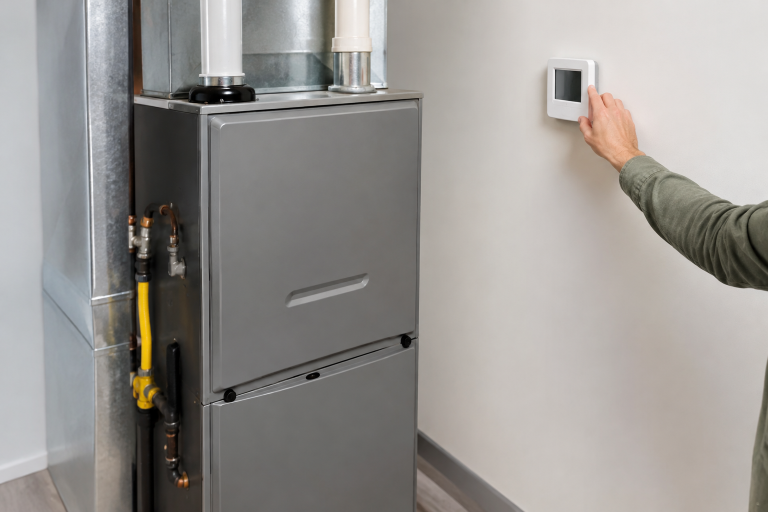
Confirm that the thermostat is set to Heat, not Cool or Off.
Set the temperature several degrees above the current room temperature.
Check whether the display is blank, dim, or showing a low-battery warning.
Replace batteries if the thermostat uses them.
Review schedules, vacation settings, and energy-saving modes that may be preventing a heating call.
A thermostat issue can look like furnace failure. If the furnace does not respond after these checks, avoid repeatedly changing settings or cycling the equipment on and off.
Inspect Power and the Furnace Switch
Look for the furnace power switch near the unit. It often resembles a standard wall switch and should be on. Next, check the electrical panel for a tripped breaker labeled furnace, HVAC, air handler, or a similar description. A breaker may be reset once if it has tripped. If it trips again, leave it off and arrange service instead of resetting it repeatedly.
If the filter was recently changed, make sure the furnace access door is fully closed. Many furnaces have a door safety switch that prevents operation when the panel is loose or misaligned.
Check the Filter and Airflow
A dirty filter can restrict airflow and contribute to overheating, short cycling, poor comfort, and unnecessary strain on the system. Find the filter, confirm its size and airflow direction, and replace it if it is visibly loaded with dust or overdue based on its label and household conditions. Homes with pets, construction dust, or heavy winter use may need more frequent checks.
Keep supply registers open and clear of rugs, furniture, and curtains.
Make sure return grilles are not blocked by storage, pet beds, or furniture.
Notice whether airflow is weak throughout the home or only in one area.
Use the correct filter size and install it in the direction shown on the frame.
Match the Symptom to a Possible Cause
No sound at all: Check the thermostat, furnace switch, breaker, and access panel. If the furnace remains unresponsive, schedule diagnosis.
Clicking or humming: This can point to an ignition, motor, capacitor, or control issue. Do not open the furnace cabinet.
Starts and stops quickly: Check the filter and open vents. Continued short cycling needs professional attention.
Blows cool air: Confirm thermostat settings and inspect the filter. Persistent cool air calls for service.
Uneven temperatures: Check for blocked registers and returns. Ductwork, insulation, airflow balance, or equipment performance may also be involved.
When to Call a Heating Professional
Call for service when safe checks do not restore heat, the furnace displays an error code, or the problem returns soon after a reset. Professional diagnosis is especially important for persistent short cycling, strange noises, unusual odors, water around the equipment, weak airflow after a filter change, repeated shutdowns, and any suspected combustion or electrical issue.
Simple Preventive Care
Check the filter monthly during heavy heating use.
Schedule professional maintenance before the main heating season.
Keep the furnace area clear of stored items and household clutter.
Test carbon monoxide alarms according to the manufacturer’s directions.
Write down error codes, unusual sounds, and when the issue began.
The U.S. Department of Energy recommends that furnaces and heat pumps receive professional maintenance each year. Good notes from the homeowner can also help a technician understand whether the issue is intermittent, airflow-related, or connected to a specific weather change or operating condition.
Frequently Asked Questions
Can a homeowner reset a furnace?
A homeowner may follow the equipment manual for one basic reset when appropriate. Repeated resets are not a repair, and a furnace that stops again should be professionally inspected.
How often should a furnace filter be changed?
The right schedule depends on the filter type, the manufacturer’s instructions, pets, dust levels, and system use. Check it regularly rather than relying only on a calendar reminder.
Why does a furnace turn on and off every few minutes?
This is called short cycling. A clogged filter or blocked airflow can contribute, but sensors, safety controls, equipment sizing, and other internal issues may also be involved.
Should a homeowner clean a flame sensor?
Internal furnace work is best left to a qualified technician. A flame-sensing issue affects safe operation, and improper handling can damage components or create a safety concern.
When is a furnace problem an emergency?
Gas odors, a carbon monoxide alarm, smoke, burning electrical smells, and repeated breaker trips should be treated as urgent warning signs. Leave the home when necessary and contact the appropriate emergency resource.
Conclusion
Olympia homeowners can often identify a simple thermostat, power, filter, or airflow issue with a careful visual inspection. Those safe checks should never replace professional diagnosis when a furnace smells unsafe, makes unusual noises, shuts down repeatedly, or fails to heat the home. Regular filter care, clear vents, carbon monoxide alarm testing, and seasonal maintenance can help prepare a heating system for the cool, wet months ahead.


0 Comments